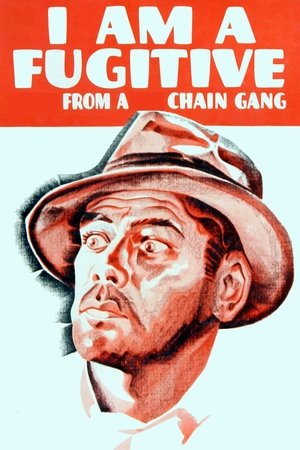
A World War I veteran’s dreams of becoming a master architect evaporate in the cold light of economic realities. Things get even worse when he’s falsely convicted of a crime and sent to work on a chain gang.
prison war veteran blackmail hamburger based on true story chain gang fugitive pre-code escaped prisoner reverend tradesman prison system prison brutality prison life prison reform innocent in jail reformed criminal escapee forced labor
Harri reviewed I Am a Fugitive from a Chain Gang (1932)
Paul Muni delivers an amazing story filled with suspense and substance
Heavily based on an autobiography of Robert Elliott Burns, I Am a Fugitive from a Chain Gang presents an incredible story, which is at the same time bafflingly realistic on various levels. The story is about young James Allen (Paul Muni) who, after returning from war and being eager to start a new modern career as a construction engineer, leaves his secure job at the local factory and travels to the industrial north to find luck. Experiencing the economic frustration of the brief Post-World War I recession, however, he is unable to find a steady job. After moving around as a drifter, he is accidentally involved in a petty robbery and is wrongfully sentenced to hard labour in a Georgian chain gang for an unspecified number of year. The plot deals with his escape, his attempts to start a new life and the attempts of Georgian officials to both bring him to justice and to exact retribution for his acts of undermining the criminal system associated with chain gangs.
The film, together with the book, parallels Beccaria's work both in its impact and content. Its significance in the eventual abolition of chain gangs was elemental and it is still able to communicate strongly to viewers about issues of crime and punishment. Parallels can be also seen in Hugo´s Les Misérables, a similarly critical treatment of dysfunctional social functions of criminology.
Besides bearing universal themes, this film is also an apt representation of cultural features in the beginning of 20th century. Fashionability of engineering, for instance, represents the growing importance of and the sense of respect for technological advancement. Allen is surfing on that wave, whereas his family is more sceptically disposed.
Social commentary is rich. Critical treatment of the strict criminal system becomes evidently the most essential part of it, as it provides insight to the effects of forced labour and harsh handling on the individual. It is also interesting to note how meticulously the plot lays out the story of Allen's development as a member of the society – how his business successes and failures play out in the aftermath of the unfair sentence and how, on the other hand, his moral character and attitude towards the society and its rules are attacked. These partially underlying issues are brought in the open in the form of judicial reviews and argumentation of the officials. The chain gang convicts, on the other hand, are largely oblivious and, more importantly, uninterested of these matters, some of them not knowing the word ”pardon”.
The depiction of the realities in labour camps is still not at all hysterical, as might be expected. Even though it soon becomes clear that the circumstances are experienced as inhumane, most of the scenes around normal day-to-day working hours do not exhibit intolerable cruelty from the guards, but rather fundamental discipline, the more violent realities being brought upon in the form of severe corporal punishments. Also, argumentation for the system, although most likely unconvincing to modern viewers, is given to us in reasonable rhetoric that draws from the film’s own material. The viewer is given well enough substance to understand why the practice was considered legitimate and pragmatic. The greatest problem is of course posed by the initial injustice inflicted on the protagonist, a feature that might have added to the depth of the film if left open, as is the case in reality. nevertheless, much is still left open, perhaps most crucially the fate of James Allen and his possible redemption. What makes the film humanist in the end, is its concern on the personal effects of injustice and strict punishment, and here, I think, lies its vital strength. How does this treatment affect this James Allen, and how does it affect people in general? Can one escape the chains put on by society?
With vivid swarm of, albeit mostly flat, characters, Paul Muni and precise editing, the flow of events summons deep involvement. It goes to illustrate my particular level of attention to the film that I never realized that the film does not have a musical score before I actually read about the fact. The sound scenario is, of course, created in a way to fill up the ”gap”. Some criticism may be given for the overt use of looping, but on the other hand, it partly serves to further remind the audience of the monotonous nature of forced labour and also the frustrating repetition of financially unsuccessful life.
Being the outstanding film it is, I Am a Fugitive from a Chain Gang is filled with various traits of genius and excellence. The ending, however, is especially notable in the history of cinema as one of the few choice ends. The last shot is indeed so powerful that it alone would certify the entirety to be classified as a unarguable classic.
All in all, I Am a Fugitive from a Chain Gang is a period masterpiece, which at the same time communicates to universal audiences. It is one of the cultural monuments of 20th century.

OR
Enter your username and email (the password will be emailed to you):